Monday, March 5, 2012

More to Pennsylvania than the Liberty Bell

I have been in Pennsylvania for about six weeks now and have run across some photographic occasions. Sadly, I don't often photograph such occasions, but here is a collection of some of the places and things I've seen while here.
Situated on a high hill in Dushore, this church is built almost exclusively of locally quarried stone. It sits on one of the highest points in town and can be seen from anywhere within the small town.
The Cell Block in Williamsport is the old Lycoming County Jail dating from the late 19th century. After it closed, it was converted into a restaurant and nightclub. Although it looks gloomy and daunting, it is really quite nice inside.
As the sign says, this is the historic Sullivan County Courthouse in Laporte. I spent most of my time here in the records room. It was built in the late 19th century, but has been extensively remodeled and restored over the last two decades.
Traveling on US 15 into Williamsport, there is a scenic overlook that offers views of both the Susquehanna River and the town of Williamsport, seen in this photo. The Endless Mountains can be seen behind the town.
US 15 runs alongside the Susquehanna River for most of its length and offers stunning views of the river. North of Harrisburg, the Susquehanna is virtually non-navigable because of currents, rapids, and the fact that at many points the river is only a foot or two deep. Thus, it makes an excellent river for canoers and kayakers and the park service maintains campsites along the river and on some of the islands for campers.
The Pennsylvania Capitol Building seen from across the Susquehanna in Wormleysburg. Harrisburg is a fairly drab town and aside from the capitol, most of the Commonwealth administrative buildings are built in the '70s concrete bunker style. I visited the State Archives one day and got to see the dinginess and bleakness first hand.
Pennsylvania is full of historic old barns that have been well maintained by farmers through the last two centuries. This particular barn is on the grounds of the Gettysburg Battlefield and most likely predates the battle.

Pennsylvania offers some wonderful historic sites and outdoor activities that I look forward to exploring further on a future vacation to the area.

We Are Met on a Great Battlefield

July 3, 1863 - Considered by many historians as the turning point of the Civil War, the Battle of Gettysburg raged for three days and cost nearly 8000 lives. Many of the casualties from both sides remain in Gettysburg, interred in the cemetery consecrated by President Abraham Lincoln several months after the battle. Established as a national battleground shortly after the war, Gettysburg was transferred to the National Parks Service in 1933. There are 1320 monuments scattered throughout the park, as well as 410 cannons.

On Sunday, I visited the park and took a ton of photos on the auto tour of the park. Due to the number of monuments and the historic points on the drive, it takes about five hours to complete. The auto tour takes you into the town of Gettysburg and to each of the landmarks of the battle - Little Round Top, the Peach Orchard, the Wheat Field, Culp's Hill, Cemetery Ridge, the Seminary. There are also observation towers scattered throughout that allow for excellent views of the entire battlefield, which consists of several hundred acres.

A lot of the photos of the battlefield itself are fairly boring. Battlefields are not glamorous, they don't make for extremely scenic vistas. Armies fought in clearings and in farmers' fields. They don't look like much. The power of the sight is in the history, of which Gettysburg has plenty.
The view from atop Little Round Top looking down at Cemetery Ridge. The area is relatively rugged with a lot of hills and boulders scattered throughout the fields. Imagine trying to cross the low ground while being bombarded by cannon fire from where I'm standing.
This small farmhouse was both a Union field hospital and General George Meade's headquarters. Meade was in overall command of the Union forces and operated from this house, which for a time was in the center of the battle.
General Robert E. Lee occupied this larger farmhouse in the northern part of the battlefield. The house is across the road from the Lutheran Seminary that gave name to Seminary Ridge.
This castle structure, which has an observation deck atop accessible via a spiral staircase within, is a monument erected by the State of New York to commemorate the New Yorkers who fought in the battle from atop Little Round Top, which is where the monument is located.
The Pennsylvania State Memorial is the largest of the monuments at Gettysburg. Erected in 1910, it commemorates the nearly 35,000 Pennsylvania soldiers that fought in the battle and has an observation deck around the dome. The photo of me waving from the deck didn't turn out unfortunately.
No battle would be complete without its cannons. This one was placed McPherson Ridge by Confederate forces, overlooking the town of Gettysburg. On the first day of the battle in 1863, it was 80 degrees. On Sunday it was hovering around freezing with 20 mile per hour winds.
Abraham Lincoln looked a little lonely sitting by himself outside the museum, so I decided to keep him company for a little while. I believe that the statue was of his actual height, which just goes to show how short I am comparatively.
I could post dozens of photos of museum exhibits, but they are not nearly as interesting as the battlefield and monuments, so I'll just show you this one. There were display case after display case of period arms - both rifles and revolvers. The museum was interesting, especially the cyclorama, a 42 foot by 365 foot oil painting depicting Pickett's Charge.
The Gettysburg Address Memorial commemorates Lincoln's speech dedicating part of the battlefield as a burial ground for fallen soldiers from both sides.
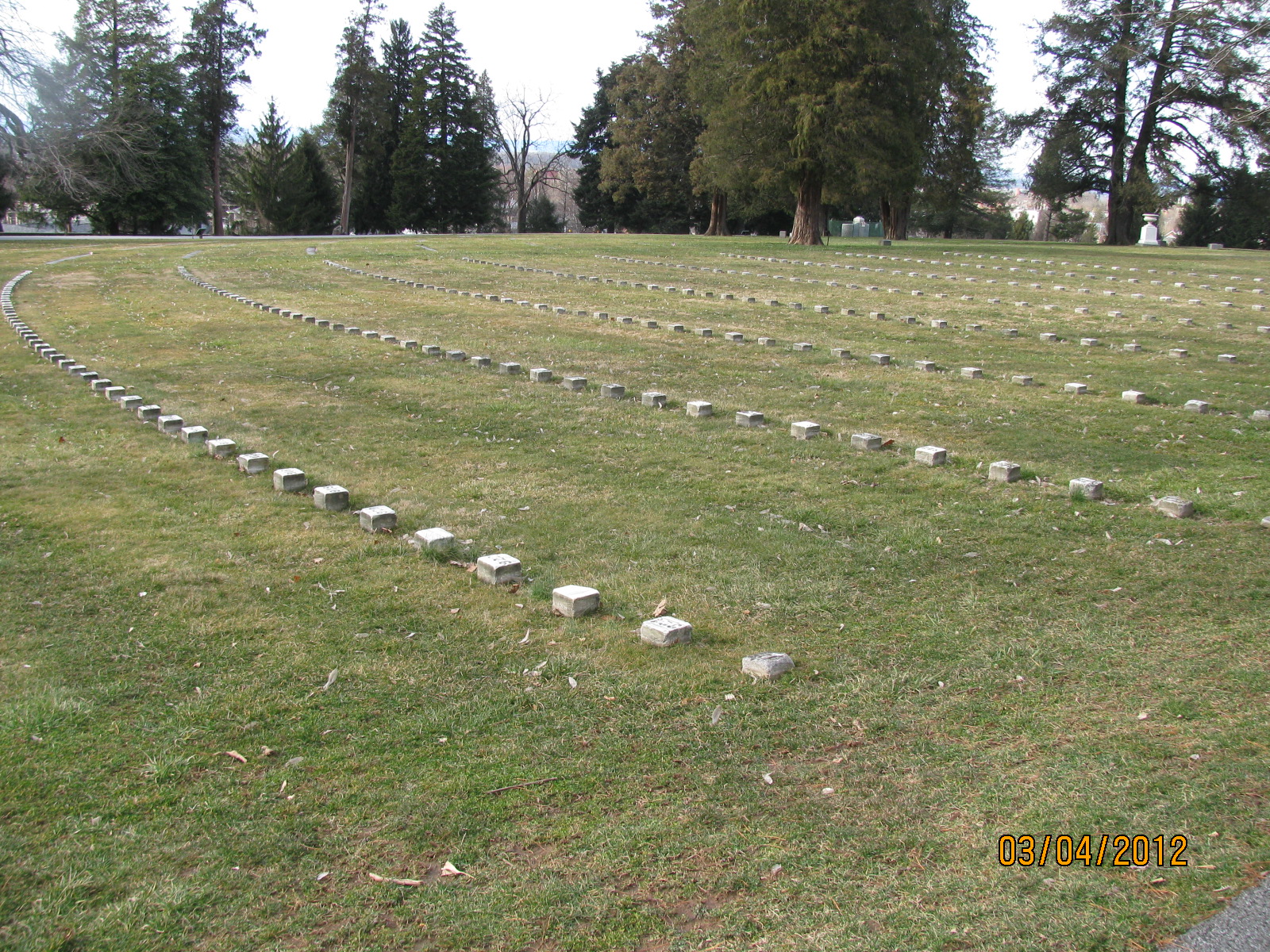
I was expecting the type of headstones normally found at military cemeteries, but instead found these - small square stones with numbers instead of names. Many soldiers were never identified and are identified only with a number. The last remains were discovered on Seminary Ridge in 1997 and interred in the cemetery.

The visit to Gettysburg was very moving and one that I would like to make again when the weather is warmer, for there are many miles of walking paths throughout the entire site to explore each and every location in which fighting occurred.

Sunday, February 12, 2012

The Bridges of Sullivan County

Okay, really just one bridge, but it is very neat. Sullivan County, Pennsylvania is home to three historic covered bridges. Two of the three were heavily damaged last year during a flood. This is the Sonestown Bridge, which I pass by everyday on my way to the Sullivan County Courthouse in Laporte, Pennsylvania, one of the smallest county seats in the entire country with about 300 people.

A few miles from Laporte, there is also a scenic overlook. The photos I took don't do the view justice, but I did the best I could.

I plan a trip to Eagles Mere, Pennsylvania sometime this week to take some photos of the beautiful old lumber baron mansions and the lake. Eagles Mere was founded as a luxury resort for the crème de la crème back in the mid-19th century and has basically remained such to this day.

Saturday, January 7, 2012

Skipped Projects: Woodpile Shelter

Continuing to take a look at old projects that were skipped for one reason or another, today we focus on the woodpile shelter that dad and I built near the three-sided shed featured in 2011. On what felt like the hottest day of the year in 2010, dad and I travelled to rural Belleville to disassemble a carport that was being used to shelter several horses in the middle of a small paddock. It took a few hours to take it down, although in the sweltering heat it seemed much longer.

Several months later, we reassembled it behind the potting shed as a shelter for the woodpile. This winter was the first time we actually filled it, although it has been used over the last year to store building supplies, straw bales, and the horse trailer.

Having used the neighbor's tractor to dig the post holes, we used seven foot two-by-fours and stakes to stabilize the four posts. If I remember correctly, the dimensions are about fifteen feet by twelve feet. We then filled the holes with dry concrete and followed with water.
Next, we bolted the cross beams into place, ensuring that they would support the weight of the roof, the beams, and would hold the posts steady. It appears that we didn't take many photos of the progress, because the next photo I found was of the finished product...
After bolting in the four exterior beams, we attached the roof beams to the exterior beams using brackets for additional support, seeing as they are rather heavy. Once done, I climbed up onto the beams and, balancing precariously, nailed the roofing panels down to the roof beams. So far it has upheld some fairly strong winds, so I guess I did a fairly good job.
Once finished, we laid a few pallets underneath and began stacking wood for winter. They burn a lot of wood over the winter - several cords worth - so every fall, the shelter has to be completely filled with wood to last long enough. Believe me, chopping and splitting wood in the middle of the winter is not fun, as evidenced by the photo below...
It's much more fun to push the old man down a hill...
It's winter again, and there will be more opportunities like this ahead. Before I left for West Virginia, I helped dad split enough wood to last through most of the winter, so he and Shawn should have plenty of time to go sledding. Despite the snow on the ground, stay green!

Thursday, January 5, 2012

Skipped Projects: Rabbit House

There have been a few projects over the last two years that I have missed including in the blog for one reason or another. I'll admit, I haven't been all that good at regularly maintaining it, especially recently now that I am in West Virginia living in a hotel. One nice thing about living in a hotel, though, is that you are forced to significantly downsize. All of my belongings can fit in the trunk of my car and if need be, I can be completely packed and moved in about a half hour. And you know what? I don't even miss all of my stuff. Sure there are a few books and clothing items it would be nice to have, but aside from that, I really couldn't care if I never see it all again.

Accumulating stuff overcomplicates our lives in an unhealthy way. We get tied to the stuff and even if we don't ever use it, we also can't bring ourselves to dispose of it. I had fallen into that habit. There were a lot of things I kept simply because I could think of something "I might be able to use it for someday." It is much easier not to have it all laying about to have to worry about.

However, I digress. This post is supposed to be about project oversight.

As winter 2010 approached, we knew we would need shelter for the rabbits. Their hutches simply were not well enough protected from the weather to enable them to survive through the worst of winter. Ultimately, we made three attempts at a solution before finding one that worked well.

The first attempt utilized some of the metal fence posts we had accumulated via craigslist and a tarp. The problem was that the tarp simply would not stay in place. It gets extremely windy at Blue Spruce Farm and the tarp simply ripped where it was connected to the poles. Plus, as you can see from first glance, it doesn't really protect the rabbits from anything except direct wind. Not a workable solution.

Solution two really wasn't any better. It involved a wood frame on the west side to better withstand the wind, but we still didn't have a solution to protect the rabbits from ice and snow. Time to return to the old drawing board...

We began to construct a post and beam shelter. Using the manual post hole diggers, we dug out holes to sink the posts into. The tree roots, compliments of the tree in the background, made this a difficult task.

Construction more or less followed that of our previous projects - rushed and lacking a specific plan. Despite that, though, the shelter shaped up rather well.

Roof supports weren't all that strong, but they did the trick.
Dad doesn't particularly care for heights, so it was my job to climb up and secure the roofing panels, which were just leftover scraps of tin from other projects. We ended up having just enough to finish the whole roof.
Now that the rabbits were protected from above, we had to decide what to do about walls to protect them from wind and sideways snow/rain.
Attempt one wasn't all that successful, but it did give us the basis for our final solution.
Straw bale wall construction! Using the extra length of the tarps, we basically folded the first two rows of bales into the tarp to protect them from moisture from the ground. To do this, we did have to attach tarps around the entire structure, but it ensure that the walls stayed strong and dry all winter. The following spring when we took the bales down, the expose bales were riddled with worms, mushrooms, and rot, but the ones that had been wrapped in the tarps were almost all dry.
The rabbits much appreciated the bale walls because it made the temperature in the rabbit shed comfortably warm all winter. After the walls were up, we didn;t even have to worry about frozen water dishes any more. It was a good thing that we finished when we did too, because the very next weekend, it looked like this...
Brrr! The rabbits stayed warm and dry all winter, though, which is more than I can say for dad and I when we went out every morning to feed and water them. Well, that's one project caught up, more will follow in the next few days since I'll be trapped at the hotel while my car is in the shop. Stay green, folks!

Monday, October 10, 2011

Hiking in the Appalachians Part One


Sunday was a beautiful day with sunny skies and a temperature hovering around 80, not bad for the mountains this time of year. After a late breakfast at Cracker Barrel with a colleague, I headed off for Valley Falls State Park again. This time, though, I didn't go down to the river. Instead, I headed up a mountain away from the river. On a poorly maintained trail circling the mountain and inclining most of the way, I quickly gained altitude, although did not get a good overhead view of the river due to the trees.

The trail branched many times as I made my way higher, and I kept taking the left branch until I meandered into a creek that feeds into the river. Much like the river, the creek was a series of waterfalls coming down the mountain, including one rather tall and scenic twin waterfall with a large pool beneath. I put down my backpack and carefully worked my way out into the middle of the creek teetering precariously on a very slippery, mossy stone to take photos of the falls. Then, having retrieved my bag, I inched my way across a downed tree trunk to the other side of the creek to check out some old brick ruins that were situated along the bank.

Making my way back to another branch, I continued along the creek for some ways, admiring the rhododendron trees that flanked both banks. At one point, the trail crossed the creek at a shallow ford, although there were stone pylons of what once was a bridge beside it. My thinking is that the trail I was on had been a road at one point many years ago. In the end, I hiked seven miles around the mountain, half of it up and half down. It took me about two hours, including the time I spent at the creek taking pictures. When I returned to my car, I was tired and sore, but already planning my next trip to explore the other trail branches, especially the one marked Rocky Trail that led straight up the mountain side to the top rather than gradually inclining around the mountain.
The trees are changing colors. The drive through the mountains to the park was spectacularly scenic.
The tallest falls of the creek, taken from a slippery rock in the middle of the creek.
The first view of the creek I had from the trail. I knelt on some rocks and dipped my hand in the water. It wasn't as cold as I thought it would be.
That is the tree I used to cross over to the other side of the creek. It isn't very big of a tree and before I made it all the way across, my weight began to break the branches.
This is the most unusual of the brick ruins near the creek. It is a circular foundation made of bricks. It was half full of water and had a dead beaver floating in it.
One of the stone pylons of the bridge that once was. Everything was covered in moss. The trees weren't very close to each other, but their canopies blocked out most of the sunlight, so there was very little underbrush. I could have hiked just about anywhere.
An ugly mug in a beautiful place.

Sunday, September 25, 2011

Don't Fall off the Rocks in the Valley

Howdy folks! It's been a long while again since I last updated, but this seems to be the easiest way to share my photos and experiences with my family, so when I see something neat on my travels, I'll post about it here.

I relocated to West Virginia last weekend to take a new job. I don't actually live here, but I'm living out of a hotel here until the current assignment is finished, however long that may be. I'm working six days a week, which doesn't leave a lot of downtime for sight seeing, but I manage to check out some local sights on Sundays. Fortunately, the weather has been good both Sundays so far.

Today, I drove out to Valley Falls State Park, a smallish park that flanks the Tygart Valley River at an area of varying height which creates a series of waterfalls. The area along the river hasn't been developed, so I got to climb around on the boulders and rocks along the river to find interesting views from which to take photos. The falls cover a fairly long section, and generate a lot of rapids, as you can see in the photos. Swimming and wading was prohibited, but they do allow kayaking. The ruins of a stone grist mill that used to occupy a spot along the falls still remain. Next weekend, if the weather holds, I'll go back and hike some of the trails in the park. The views are amazing.

These stone pillars are the only remains of the old mill.
The water looked so inviting, it was hard not to jump in.
This was an interesting area - a pool formed by large boulders with five waterfalls feeding it.
I climbed down to rocks just barely above water level to take some of these photos. It was slippery, but worth it.
The roar of the water was deafening. Had a ranger been yelling at me to stay off the rocks, I never would have heard them. ;)
This was a really neat outcropping in the rocks. You can see from the standing water below it that the river at times covered the area I was standing.
Don't you just love waterfalls?
A view of many of the major falls from downriver. Lots of boulders worn smooth over the centuries.
Even downriver, the rapids were still wicked. This is what makes this such an awesome kayaking spot.
A lone boulder in the middle of the river creating rapids. Had I been able to get there, I would have had an awesome view of the entire system of falls and rapids.

The best part about this park was that while there were signs saying "stay out of the water", there weren't any saying you had to stay on the trails. Thus, I felt that this was an invitation to climb all over the rocks and boulders, and attempt scaling the rock walls farther from the river. Definitely on my list of places to go back to, especially since it is nearby and free - only took me about 15 minutes to get there on a road that wound through the mountains with straight up on one side and straight down on the other. I made sure to drive faster than was probably safe just for the thrill. :D